
In our first part of our private wealth series focusing on succession planning, we highlighted three interdependent elements which determine whether transitions succeed or fail and they are
1. Leadership,
2. Ownership, and
3. Governance.
Each pillar matters. None works in isolation.
This article focuses deliberately on Leadership not because it is more important than the other two, but because it is often the most personal, the most deferred, and the least openly discussed aspect. For many business owners and founders whom we have observed in our line of work, we noted that leadership transition is not necessarily a lack-of-planning problem but more of a letting-go problem.
Leadership Change Is Not a Technical Decision
Leadership transition is frequently framed as a technical question:-
- Who is capable?
- Who is qualified?
- Who should be named as the “next CEO”?
These are necessary questions, but they are rarely the ones that stall succession.
What slows leadership change is the reality that stepping aside forces founders to confront, more often than one would like to admit, a change in identity, a loss of direct control and / or uncertainty over whether the next leader in line will protect what took decades to build.
The resulting outcome is one where leadership succession is often postponed until circumstances dictate timing rather than intention. The issue does not appear to us as an absence of intelligence, resources, or advisors. It is basic human reluctance.
The Intention – Action Gap in Leadership Transitions
Most business owners intellectually accept that leadership transition is inevitable. However, action frequently lags intention.
Often, leadership change is deprioritised because, or perhaps, the business is still performing well or the current leader remains highly capable and / or no immediate disruptions are appearing on the horizon.
Ironically, these are precisely the conditions under which leadership transition should be addressed. Preparing for leadership change before it becomes urgent preserves choice whilst waiting until it becomes necessary narrows it. It should then follow that leadership succession is less about timing an exit perfectly and more about ensuring that transition, when it comes, is deliberate rather than forced.
Acknowledging that Letting Go Is a Leadership Competency
One of the least acknowledged aspects of leadership transition is that the ability to let go
is itself a leadership skill.
Founders often struggle not because successors are incapable, but because:
- authority is never genuinely transferred,
- decisions remain informally centralised,
- or responsibility is delegated without real autonomy.
In such environments, successors cannot develop credibility, be it internally or externally
and founders remain indispensable by default.
Effective leadership transition happens progressively when:
- authority is shared before it is surrendered,
- successors are allowed to make decisions and mistakes,
- and success is redefined from personal control to institutional continuity.
Acknowledging that Leadership Readiness Is Not the Same as Lineage
In family owned and owner managed businesses, leadership succession is often constrained by implicit assumptions that the next leader should come from within the family or that appointing professional management (outside the family) signals loss of legacy and / or that leadership and ownership must reside in the same person or family.
"In our observations, leadership, ownership, and governance do not need to converge in a single individual or stays within the family.”
Separating these roles create flexibility:
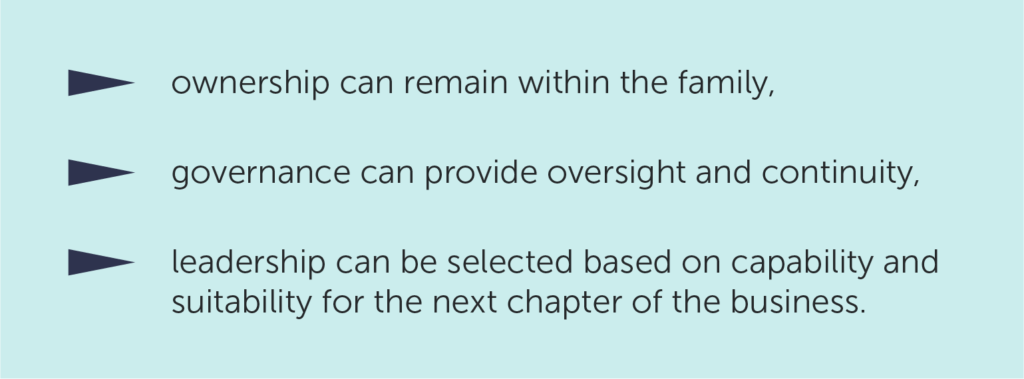
Clarity around leadership criteria reduces conflict and protects both the enterprise and family relationships.
Preparing the Organisation for Leadership Change
Leadership transition is not a private family conversation. It is an overarching organisational process.
Employees, management teams, lenders, regulators and key partners all respond to leadership uncertainty. When leadership succession is unclear:
- decision making slows,
- authority becomes ambiguous,
- institutional confidence erodes quietly before it becomes visible.
Preparing the organisation involves:
- clarifying interim and future leadership roles,
- aligning governing bodies on the transition approach,
- and ensuring continuity of direction even as leadership evolves.
Trust is built when leadership change appears intentional, not accidental.
Leadership Transition Readiness Checklist
Questions to which business owners and family principals should be asking now
This checklist is not a scorecard but is intended to be a diagnostic tool designed to surface blind spots early and while choices remain available.
1. Readiness of the Current Leader
-
- Have I accepted that my role will change, even if I continue contributing?
- Am I prepared to move from decision‑maker to steward, mentor, or chair?
- Can I allow others to make consequential decisions without intervening?
- Is my future involvement defined or merely assumed?
2. Clarity on Leadership Criteria
- Have we articulated what leadership this business needs for its next phase and not its past?
- Are leadership criteria explicit and shared or implicit and assumed?
- Are successors assessed on capability and temperament rather than lineage?
- Have we separated potential from readiness?
3. Development of Successors
- Are successors given real authority or only symbolic responsibility?
- Do they have exposure beyond the family business?
- Is there a structured development pathway?
- Are mistakes treated as learning and not threats?
4. Organisational Preparedness
- Would the business remain stable if leadership changed unexpectedly?
- Are decision rights and escalation pathways clear during transition?
- Has leadership succession been considered from the perspective of key stakeholders?
- Does the organisation understand how leadership change will be managed?
5. Alignment with Ownership and Governance
- Is leadership transition aligned with ownership expectations?
- Is there an effective board or governing body to oversee transition?
- Are roles clearly separated between owners, family and non-family members and executives?
- Does governance have real authority to support or intervene if needed?
A Final Thought
Leadership transition rarely fails because the “wrong” leader was chosen. It fails because leadership conversations are delayed until
options are limited.
Readiness is not about choosing who will take over today. It is ensuring that when leadership change occurs, planned or otherwise, the business, the family and the next leader are not learning or caving under undue pressure.
How CLA Global TS Can Assist
At CLA Global TS, we work with business owners and families to approach leadership transition as a structured, deliberate process, rather than a reactive decision.
We support clients by helping them:
- surface and reconcile unspoken assumptions around leadership and control,
- align leadership transition with ownership and governance realities,
- design credible development pathways for next‑generation or professional leaders,
- and build transition frameworks that protect both enterprise value and family continuity.
Whether leadership change is imminent or still years away, early clarity expands choice and reduces risk.
If leadership transition is on your horizon, even if the timing feels uncertain, we would be pleased to explore how to approach it methodically, pragmatically, and on your terms.
View the full article in PDF here.
CONTACT US
CLA Global TS Private Wealth Specialists
 |
Edwin Leow Co- Advisory Leader Director, Head of Tax edwinleow@sg.cla-ts.com |
 |
Shaun Zheng Director, Tax shaunzheng@sg.cla-ts.com |
 |
Tan Xin Yi Manager, Tax tanxinyi@sg.cla-ts.com |
 |
Else Guo Manager, Tax elseguo@sg.cla-ts.com |