Companies today face a volatile business environment, where shifting trade and tariff policies make strategic leadership more critical than ever.
Beyond the added pricing pressures from tariffs, business leaders must also navigate existing challenges such as inflation, technological disruption, an evolving competitive landscape, talent shortages, and changing customer behaviours. In general, leaders view geopolitical, macroeconomic, and trade uncertainty as key risks to business growth.
Business as usual is no longer an option.
Successful leaders embrace uncertainty and turn it into opportunity—planning carefully, acting decisively, and shaping the future with confidence. By integrating agility with disciplined governance, Boards and Management can strategically position their organisations to navigate uncertainty and emerge more resilient and competitive.
Mitigating the Potential Impact of Increased Tariffs on Businesses
This disruption is demanding a strategic review of businesses from supply chain to portfolio optimisation, from cost management to financial resilience.
Business leaders need to navigate regional economic shifts with local sensitivity and global awareness. Geopolitical risk management is now a key consideration of strategic planning, as the world pivots towards deglobalisation and a more regionalised economy.
Strategies to mitigate the potential impact of increased tariffs on businesses include the following:
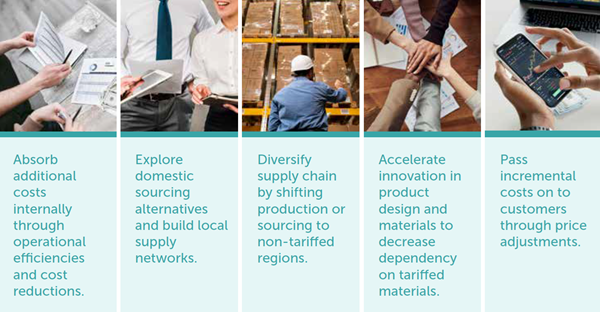
Artificial intelligence (AI) and automation can help companies reduce operational costs and achieve effciency gains. This can help them absorb the impact of tariffs without solely relying on cost management. Additionally, the predictive analytics capability of AI allows for better forecasting, scenario planning and identification of new business opportunities, helping companies to respond proactively to market changes.
Navigating the Volatile Market Through Strategies
Turbulent times also present opportunities.
While escalating market volatility due to shifting trade and tariff policies is likely to delay investment decisions, the strategic rationale for deal-making remains. With a clear strategy, disciplined execution and strong leadership, Mergers & Acquisitions (M&A) remain a powerful lever to create long-term value, where companies can unlock synergies, preserve their competitive edge and drive growth well beyond short-term financial returns. M&A remains a Board agenda as companies still have a M&A appetite, driven by a transformation imperative.
Strategic investments must be carefully navigated in a volatile market.
A volatile market often leads to asset mispricing, where intrinsically valuable companies could trade at substantial discounts to their long-term potential. Buyers with strong balance sheets can capitalize on these temporary valuation compressions. It is too early to estimate the full impact of the evolving tariff situation will have on corporate investments.
Companies pursuing M&A require clarity on macroeconomic factors to accurately value target assets. Economic growth trajectories directly impact future revenue projections and market opportunity sizing, making them fundamental to any valuation model. Without reliable growth forecasts, buyers risk overpaying for assets whose potential may not materialize.
Tax, Tariffs & Capital Market Conditions – Understanding the Costs
Tax and tariff policies significantly affect post-acquisition cash flows and integration costs. Shifts in corporate tax rates, international trade policies or sector-specific levies can significantly change the deal numbers, turning profitable deals into value-destroying actions.
Capital market conditions establish the baseline for valuation multiples and financing costs. Fluctuations in interest rates, equity premiums, foreign exchange rates, and debt availability influence acquisition prices and structure.
M&A: Value Creation & Long Term Growth
In volatile markets, the valuation gaps between buyer and seller expectations often widen and these potential valuation gaps could be a complexity that could slow M&A activity. Buyers must develop robust scenarios to stress-test assumptions and build appropriate risk premiums into their valuation models, ensuring strategic transactions deliver their intended value.
While it is often cited that many deals fail to deliver shareholder value due to integration hurdles, cultural misalignment or overestimated synergies, with
the right strategy, execution and leadership, M&A can be a powerful driver of value creation and long-term growth.
The potential value of M&A is not always fully understood. Short-term performance metrics around immediate financial returns may overlook long term strategic benefits. Successful acquirers develop repeatable integration capabilities that improve outcomes over time. Defensive acquisitions that prevent competitive disadvantages represent value preservation rather than destruction.
Value creation is derived from synergies such as cost effciencies, complementary capabilities, market access expansion, or innovation acceleration. Deals with clear strategic rationales that extend beyond mere scale tend to outperform pure consolidation plays.
Critical success factors include disciplined target selection with thorough due diligence, rational premium payment that preserves acquisition economics, and
meticulous integration planning that begins well before closing.
Cultural compatibility proves equally decisive, as organisational friction can erode theoretical synergies.
Timing is also critical, as acquisitions executed early in industry transformation cycles or during market downturns can generate superior returns.
Summary
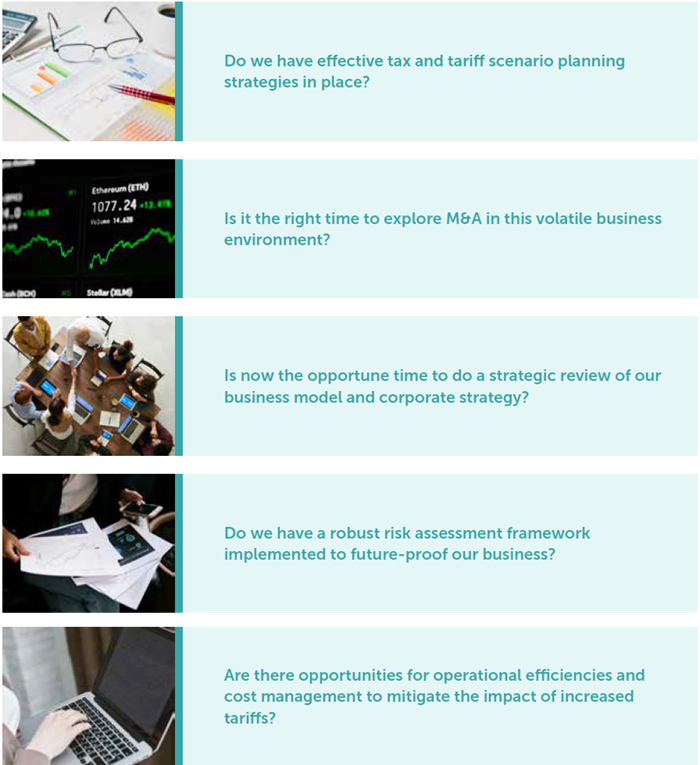
In summary, a majority of senior management across companies, across industries, and across geographies are concerned about the short, mid, and long term tariff impact, triggering the following strategic questions and call to action:
How Can CLA Global TS Help?
Our Management Consulting Specialists possess in-depth experience to devise constructive strategies to tackle the challenges of today’s volatile market. Management plays a pivotal role in guiding a business through such uncertain times and is essential that corporations and businesses understand the impact of the decisions made. As such, companies should take precautions and seek consultations in order to ensure decisions made would be able to comfortably and safely navigate the company through the volatile market.
For all questions or concerns on Management Consultation matters, please speak to our specialists.
View the full article in PDF here.
CONTACT US
Contact our Management Consulting Specialist for a Discussion
 |
Yu Shilong Head of Consulting & Corporate Development Director yushilong@sg.cla-ts.com |