
Mergers and acquisitions represent pivotal moments in any business journey. Whether you are considering selling your company or acquiring another, understanding the transaction process can mean the difference between success and costly mistakes.
This guide explores essential merger and acquisition considerations to help business owners navigate this complex landscape with confidence.
Key Takeaways
- Strategic planning precedes execution. Successful deals require thorough preparation before entering negotiations, including conducting a business valuation and identifying targets.
- Due diligence protects your interests. A comprehensive review of financial areas, corporate matters, and key risks ensures you understand what you’re buying or selling.
- Integration determines value realisation. The combined company’s success depends on smooth integration planning that begins before the deal closes.
- Professional guidance maximises outcomes. Working with m&a advisors and m&a strategy consulting experts helps navigate regulatory implications and complex negotiations.
Understanding Mergers and Acquisitions
A merger is the combination of two companies into a single entity. An acquisition occurs when one company purchases another.
While these terms are often used interchangeably, the distinction matters for tax purposes and legal structure.
In mergers, both companies contribute assets to form a single entity. On the other hand, acquisitions involve the acquiring company taking control of the target company through asset purchases or share purchase agreements. The target entity may remain a separate legal entity or be fully absorbed.
Determining Your Strategic Fit
Before pursuing any deal, assess why you’re considering this transaction. Strategic planning should address how the acquisition strategy aligns with your business goals.
Many business owners pursue mergers and acquisitions to increase market share or access new customer bases. The market opportunity should be clear and measurable.
Successful deals create value that neither company could achieve on its own. The outcomes might include cost reductions, expanded capabilities, or enhanced market presence.
When two companies combine, the combined company’s shareholder value should exceed the sum of what they generated separately. Consider whether the target identification process reveals companies that offer genuine strategic fit with your organisation.
Business Valuation Fundamentals
Accurate valuation forms the foundation of fair pricing in any transaction. Understanding business value requires examining multiple factors and employing various analytical methods.
Professional M&A advisors provide advisory services, including comprehensive business valuations, to help determine fair pricing.
Several approaches help assess what the business is worth:
- Income-based methods analyse future cash flows and discount them to present value
- Market comparables examine similar recent transactions to benchmark pricing
- Asset-based approaches assess net assets and acquired assets directly
Review historical performance, projected growth, and the capital structure carefully. Understanding these financial areas helps gauge market interest from potential purchasers.
Never settle for a single potential purchaser without exploring the full market interest, as competitive tension often yields maximum value.
The Due Diligence Process
Due diligence is a critical phase where buyers verify a target company’s information, validate deal assumptions, and reduce risk.
Financial Diligence
Financial diligence involves thoroughly examining financial statements, revenue streams, and cash flow patterns. Quality of earnings reports assess how the business generates revenues and distinguish between recurring and one-time income. This diligence helps confirm the final price reflects true business value.
Legal and Regulatory Review
Legal and regulatory review evaluates contracts, intellectual property rights, and litigation history. Verify that intellectual property is properly protected and owned by the target entity. Review any ancillary contracts that could affect operations post-acquisition.
Operational Assessment
Operational assessment analyses systems, processes, and organisational structure carefully. Assess the target company’s management team and employee capabilities, as cultural compatibility often determines the integration process.
Technology systems require special attention, including IT infrastructure, data protection measures, and cybersecurity protocols.
Managing the Acquisition Process
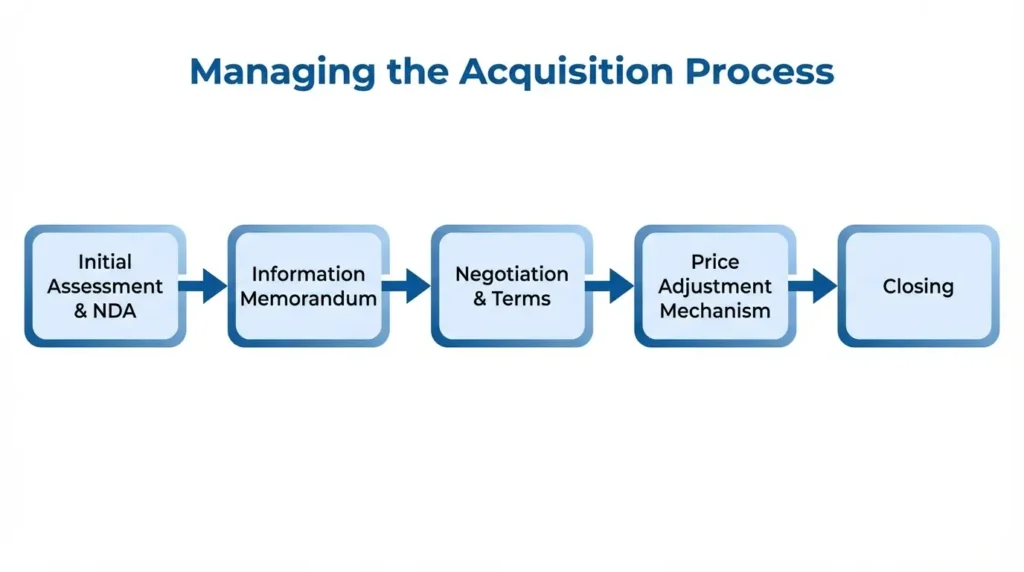
The path from initial interest to closing involves several structured phases. Before sharing sensitive business information, establish protection through a non-disclosure agreement.
Prepare an information memorandum that provides sufficient detail for any potential purchaser to evaluate the opportunity.
Negotiation focuses on discussing proposed terms, including purchase price, payment structure, and conditions. Decide between asset purchases and equity transactions, as each structure carries different regulatory implications.
Asset purchases allow buyers to select specific business assets while avoiding unwanted liabilities. Share purchase agreements transfer complete ownership, including all obligations and any further obligations.
Many deals include a price adjustment mechanism based on final financial results. These provisions address changes between signing and closing, ensuring that the price reflects actual business conditions at the time of transfer.
Structuring the Deal
How you structure your transaction affects everything from taxation to future obligations. Consider these two common scenarios:
Scenario 1: Asset Purchase
A manufacturing company wants to acquire a competitor’s production facility and equipment, but wants to avoid inheriting environmental liabilities.
Through asset purchases, the buyer acquires specific business assets, such as machinery, inventory, and customer contracts, while retaining certain liabilities.
This approach appeals to acquiring companies seeking to minimise risk exposure and select only desired elements.
Scenario 2: Share Purchase
A tech firm acquires a software company to gain its entire operation, including employees and ongoing contracts.
Through a share purchase, the buyer acquires a controlling interest and assumes all assets and liabilities. The acquired company becomes either a subsidiary or part of the single entity, maintaining continuity for customers and employees.
Decide whether the target company continues as a separate legal entity or merges completely into one company.
Some deals benefit from maintaining distinct entities initially, while others achieve maximum value through immediate consolidation.
Identifying and Mitigating Key Risks
Every transaction carries risks that must be identified early. Understanding and addressing key risks protects your investment and prevents costly surprises:
- Financial risks include hidden debt, declining revenues, or unsustainable margins, which can devastate deal value. Thorough financial due diligence reveals these concerns before commitment.
- Operational risks often emerge from incompatible systems or processes between organisations. Cultural clashes between the two companies can undermine productivity. Plan how the combined company will address these friction points before the acquisition occurs.
- Market risks arise from external factors that affect deal success. Economic conditions and competitive pressures influence whether anticipated outcomes materialise. Assess how market dynamics may affect the business post-acquisition and develop contingency plans accordingly.
Navigating Regulatory Requirements
Mergers and acquisitions are subject to various regulatory requirements depending on the industry and transaction size. Understanding these obligations early prevents delays and complications during the transaction process.
Step 1: Identify applicable regulations. Determine which regulatory requirements apply based on the industry, jurisdictions involved, and transaction size.
Step 2: Assess antitrust and competition risks. Evaluate whether the transaction may reduce market competition and require pre-approval from competition authorities.
Step 3: Build regulatory approvals into the timeline. Account for potential approval processes that may take several months to avoid delays.
Step 4: Review existing contracts for change-of-control clauses. Identify agreements that require third-party consent or allow termination upon a change in ownership.
Step 5: Notify affected parties and secure consents. Issue required notifications and obtain approvals before closing to prevent contract termination and business disruption.
Step 6: Address data privacy and protection requirements. Review data transfer obligations across jurisdictions and industries when customer or sensitive data is involved.
Step 7: Plan secure data management post-merger. Establish controls for handling sensitive business and customer information to ensure compliance and avoid regulatory penalties.
Working with Professional Advisors
The complexity of mergers and acquisitions makes professional guidance essential. M&A advisors help with target identification, business valuation, and negotiation strategy. They bring market knowledge and transaction expertise. Advisors can gauge market interest by approaching multiple potential buyers, creating competitive tension.
M&A strategy consulting firms help define your acquisition strategy and assess strategic fit. They guide clients through complex decisions about deal structure and integration planning. These advisory services support strategic planning that aligns deals with long-term business objectives.
Legal professionals draft necessary documents and ensure regulatory compliance. They cover legal protections through comprehensive agreements. Accountants address fiscal implications and financial modelling. Their expertise helps determine fair pricing and identify potential issues.
Planning for Integration Success
Integration begins long before the deal closes and determines whether the acquisition creates or destroys value. Helping businesses navigate this transition requires careful preparation.
Define clear objectives for the combined company early. Decide on the integration approach—whether full absorption, partial integration, or maintaining autonomy. This acquisition strategy should reflect your deal rationale and synergy targets.
Different corporate cultures can clash if not addressed proactively. Communicate openly about changes and expectations. Foster a unified vision that respects both organisations’ strengths.
Plan system migrations, process alignment, and organisational restructuring in advance. Smooth integration minimises disruption and preserves value. Prepare for immediate post-closing needs, including clear communication to employees and customers.
Maximising Deal Value: Best Practices and Pitfalls to Avoid
Success in mergers and acquisitions requires both knowing what to do and what to avoid. Follow these best practices to avoid common mistakes.
Best Practices for Maximum Value:
Begin planning before approaching the market. Organise your finances, document processes, and proactively address weaknesses. Preparation positions you to move quickly when opportunities arise and strengthens your bargaining power.
Establish non-negotiable requirements before negotiations begin. Understand when to decline rather than accept unfavourable terms. This discipline prevents regrettable deals driven by emotion or pressure.
Don’t let the transaction distract from running the business daily. Declining performance during negotiations reduces value. Keep your team focused on delivering results throughout the process.
Assemble advisors with relevant experience in your industry. Their expertise in navigating corporate matters proves invaluable. Quality guidance prevents expensive mistakes.
Common Pitfalls to Avoid:
Rushing the diligence process or accepting incomplete information creates unnecessary risk. Allocate sufficient time to fully understand the business. Uncover issues before signing agreements rather than discovering them afterwards.
Emotional attachment or competitive pressure can inflate pricing beyond reasonable levels. Rely on objective business valuation rather than optimism. Paying too much undermines the potential for value creation.
Focusing only on deal completion without planning afterwards courts failure. Integration determines whether expected results materialise. Begin this planning during diligence, not after closing.
Uncertainty breeds anxiety among employees and customers. Communicate consistently throughout the process to maintain trust and stability.
Considerations for Smaller Companies
A smaller company typically has fewer people to dedicate to the transaction process. Carefully balance deal activities with operational demands. Consider external support to supplement internal capabilities.
Large acquirers have more negotiating leverage and resources. However, multiple interested buyers increase your bargaining power substantially. This highlights the value of working with m&a advisors.
Smaller deals often involve less formal documentation and faster timelines. However, this doesn’t reduce the importance of thorough diligence.
Tax, Financial, and Deal-Specific Considerations
Understanding the fiscal implications and deal-specific factors helps you structure transactions optimally for your situation.
| Transaction Type | Tax Impact on Seller | Tax Impact on Buyer | Risk Transfer |
| Asset Sales | Immediate tax liability | Depreciation benefits | Lower (selective) |
| Stock Sales | Deferred taxation | Limited tax benefits | Higher (complete) |
Tax and Financial Implications
Different transaction structures produce varying tax consequences. Asset sales may trigger immediate tax liability for sellers but offer depreciation benefits for buyers. Stock sales often defer taxation but transfer more risk.
Work with tax advisors early to model scenarios. Optimise the structure for both parties when possible. Consider how the capital structure will look post-transaction and whether it supports future goals.
Determine how to fund the acquisition. Options include cash, debt, equity, or combinations. Each affects financial flexibility differently and presents its own sets of tax implications / considerations.
How the purchase price is allocated among assets matters for tax purposes. Assign values to tangible assets, intellectual property, and goodwill thoughtfully. This allocation affects future deductions.
Deal Type Considerations
Strategic acquirers buy for the business advantages and long-term strategic fit with existing operations. Financial buyers focus on return on investment and exit strategies. Understanding your counterpart’s motivation helps structure beneficial terms.
Most transactions proceed cooperatively with willing participants. Occasionally, a hostile takeover attempt occurs when boards reject offers deemed inadequate. These situations involve different strategies and tactics.
Regulations vary significantly by sector and must be understood thoroughly. Healthcare, financial services, and other regulated industries require specialised expertise. Ensure your advisors understand your industry’s specific requirements.
Preparing for Success: Partner with Expert M&A Strategy Consulting
Successfully navigating mergers and acquisitions requires experience, market knowledge, and strategic insight. The considerations outlined in this guide represent the beginning of what makes deals succeed.
From initial strategic planning through final integration, every phase demands careful attention. Business valuation, due diligence, negotiation, and integration require specialised knowledge. The stakes are too high to proceed without professional guidance.
Whether you’re considering acquiring a company to expand your market presence or exploring a sale to maximise the value you’ve built, partnering with experienced advisors makes the critical difference. Understanding how to set fair prices, structure optimally, and create long-term value requires deep expertise.
Ready to explore your M&A options?
The team at CLA Global TS brings decades of experience helping businesses navigate successful mergers and acquisitions. Our comprehensive advisory services cover strategy development, business valuation, diligence management, and integration planning.
We guide clients through every aspect of the transaction process.
Contact us today to discuss how we can help you achieve maximum value through strategic M&A transactions.