
Singapore’s dynamic business environment offers exceptional opportunities for companies seeking sustainable growth through strategic acquisitions.
As a global financial hub ranked second in the World Bank’s Ease of Doing Business Index, Singapore offers an ideal environment for mergers and acquisitions.
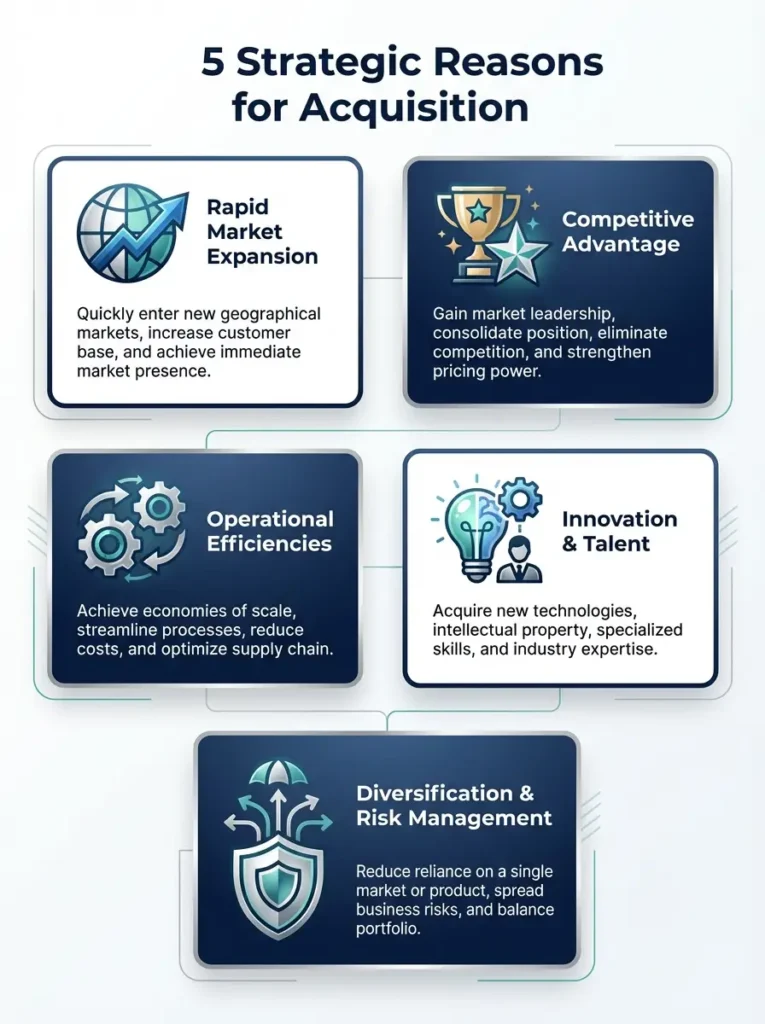
Here are 5 reasons for acquisition that can help businesses leverage this powerful growth strategy effectively.
Key Takeaways
- Accelerated Market Expansion: Acquisitions enable rapid entry into new markets and territories without the lengthy setup required by organic growth.
- Competitive Advantage Through Consolidation: Acquiring competitors increases market share and eliminates competitive threats in your industry.
- Enhanced Operational Efficiencies: Strategic acquisitions create synergies that reduce costs by leveraging shared resources and streamlining operations across the broader organisation.
Access to Innovation and Talent: Companies gain immediate access to innovative technologies, intellectual property, and skilled talent pools through targeted acquisitions.
1. Rapid Market Expansion and Increased Market Share
One of the most compelling reasons for acquisition is the ability to achieve rapid business growth. When two companies merge or when one company acquires another, the acquiring company instantly expands its market presence without the time-consuming process of building from scratch.
The acquisition process offers speed that organic growth simply cannot match. Instead of spending years establishing new customer bases and distribution networks, companies can acquire an existing target business with proven operations. This approach is particularly valuable in Singapore’s competitive landscape, where timing and market positioning are critical.
By absorbing a target company, businesses immediately gain access to:
- Established customer bases in new geographic regions
- Proven distribution networks and supply chain infrastructure
- Existing market presence and brand recognition
- Operating licenses and regulatory approvals
For example, when a larger company acquires a smaller competitor in the same industry, it can quickly increase market share while simultaneously reducing competition. This strategic move creates a stronger market position that would take years to achieve through organic expansion alone.
Singapore’s Enterprise Financing Scheme supports M&A activities, providing funding options that make acquisitions more accessible. This government backing demonstrates Singapore’s commitment to guiding businesses toward sustainable growth through strategic partnerships, mergers and acquisitions.
2. Achieving Economies of Scale and Cost Savings
Strategic acquisitions create significant operational efficiencies through economies of scale. When companies merge, they can achieve economies that dramatically reduce per-unit costs and improve profitability.
The larger business resulting from an acquisition can negotiate better terms with suppliers due to increased purchasing power. Bulk purchases become more economical, and the combined capital structure provides stronger financial leverage. These cost savings extend across multiple areas:
- Production and Operations: Consolidated manufacturing facilities and streamlined operations eliminate redundancies. Companies can optimise production schedules and reduce overhead costs.
- Supply Chain Optimisation: A unified supply chain allows businesses to negotiate volume discounts and improve logistics efficiency. The combined entity can leverage its size to secure preferential vendor terms.
- Shared Resources: Merging companies can consolidate administrative functions, IT systems, and back-office operations. This integration reduces duplicate expenses and creates a leaner organisational structure.
Post-merger integration, when executed effectively, transforms these potential savings into actual value.
Advisory services specialising in M&A support can help businesses implement strategies that maximise these operational benefits while ensuring minimal disruption to ongoing operations.
The acquisition services provided by experienced consultants focus on comprehensive due diligence to identify synergy opportunities before the deal closes. This preparation is an essential part of successful integration planning.
3. Gaining Competitive Advantage and Reducing Competition
Acquisitions are a powerful tool for reducing competition and strengthening your market position. When companies acquire direct competitors, they eliminate market alternatives for customers and consolidate industry power.
This strategic approach offers several competitive advantages:
- Market Consolidation: By acquiring competitors, businesses gain a larger share of the target market. This increased market share translates to greater pricing power and market influence.
- Barrier to Entry: A larger, more established company creates higher barriers for new entrants. Competitors face a more formidable market leader with extensive resources and market coverage.
- Enhanced Negotiating Power: Greater market share strengthens negotiating positions with suppliers, distributors, and even customers. This leverage can improve terms across the entire value chain.
- Strategic Positioning: Acquisitions allow companies to position themselves advantageously before competitors can respond. First-mover advantage in consolidating fragmented markets can create lasting competitive benefits.
Singapore’s regulatory framework ensures fair competition while supporting strategic business combinations. Companies must navigate regulatory hurdles carefully, but the benefits of reduced competition make this worthwhile for long-term success.
The business strategy of acquiring competitors works particularly well in mature markets where organic growth has plateaued. Rather than fighting for a limited market share, companies can expand through strategic acquisitions that fundamentally reshape competitive dynamics.
4. Access to Innovation, Technology, and Intellectual Property
In today’s digital transformation era, acquiring innovative technologies and intellectual property represents a critical growth strategy. Companies frequently pursue acquisitions to gain access to capabilities that would take years to develop internally.
Technology acquisitions offer multiple strategic benefits:
- Accelerated Innovation: Rather than investing years in research and development, companies can acquire firms with proven innovative technologies. This approach compresses development timelines and reduces technical risk.
- Intellectual Property Acquisition: Patents, trademarks, and proprietary technologies become immediate assets. This intellectual property can provide sustainable competitive advantages and create new revenue streams.
- Digital Capabilities: As businesses undergo digital transformation, acquiring technology companies provides instant capabilities. Legacy companies can modernise their service offerings without lengthy internal transformation programs.
- Talent Acquisition: Technical acquisitions bring specialised talent that’s difficult to recruit individually. Entire teams of engineers, developers, and researchers join the acquiring organisation.
Singapore’s robust intellectual property protection framework makes it an ideal location for technology-focused acquisitions. The city-state’s commitment to innovation and strong legal protections ensures that acquired intellectual property remains secure.
Many larger businesses pursue “acqui-hire” strategies, where the primary value lies in the target firm’s talent rather than its current business. This approach has become increasingly common in sectors experiencing rapid technological change.
Comprehensive due diligence during the acquisition process should thoroughly evaluate the target business’s technology assets, development pipeline, and technical team capabilities. Understanding these elements ensures the acquisition delivers the expected value of innovation.
5. Diversification and Risk Management
Strategic acquisitions enable businesses to diversify operations and implement robust risk management strategies. By expanding into complementary markets or vertical integration opportunities, companies reduce dependence on single revenue streams.
Diversification through acquisition provides several protective benefits:
- Revenue Stream Diversification: Adding new product lines or service offerings through acquisitions creates multiple revenue streams. This diversity protects against downturns in any single market segment.
- Geographic Diversification: Expanding into new markets reduces regional risk. Singapore’s strategic location makes it an excellent base for acquisitions targeting Southeast Asian expansion.
- Supply Chain Security: Vertical acquisitions that bring suppliers or distributors in-house reduce external dependencies. This integration provides greater control over the entire value chain.
- Market Cycle Balance: Acquiring businesses across different industry segments can help balance cyclical fluctuations. When one sector faces headwinds, others may provide stability.
- Joint Ventures and Strategic Partnerships: Beyond full acquisitions, these partnerships allow companies to share risks and access new opportunities. These arrangements provide flexibility while building long-term value.
Singapore’s stable political environment and strong reputation make it an ideal location for companies pursuing diversification strategies. The country’s extensive network of free trade agreements provides access to regional markets, enhancing the value of acquisitions targeting expansion.
Risk management through acquisition requires careful strategic planning. Companies must evaluate how potential targets complement existing operations while genuinely reducing overall business risk. Advisory services specialising in M&A can help identify opportunities that provide meaningful diversification benefits.
Post-acquisition integration challenges must be addressed to realise the benefits of diversification. Cultural differences, operational incompatibilities, and integration difficulties can undermine the strategic rationale. Professional guidance helps navigate these obstacles effectively.
Building Your Acquisition Strategy for Long-Term Success

Developing a successful acquisition strategy requires careful consideration of multiple factors. Companies must align their business strategy with acquisition targets that genuinely support growth objectives.
- Strategic Planning: Effective mergers and acquisitions begin with clear strategic goals. Businesses should identify what they hope to achieve—whether market expansion, technology acquisition, or competitive consolidation—before pursuing potential targets.
- Comprehensive Due Diligence: Thorough investigation of target companies is critical. Financial health, operational performance, cultural fit, and integration feasibility all require careful evaluation. Expert guidance from M&A specialists ensures nothing important gets overlooked.
- Valuation and Deal Structure: Proper valuation protects against overpaying. Understanding the target firm’s true value, including intangible assets and synergies, helps structure deals that create value for investors and stakeholders.
- Integration Planning: Success depends on post merger integration execution. Companies should develop detailed integration plans that address operations, culture, systems, and personnel. Minimal disruption to ongoing business is essential.
- Regulatory Compliance: Singapore’s business-friendly environment includes clear regulatory frameworks. Companies must ensure compliance while leveraging available incentives and support programs.
The acquisition process involves multiple stakeholders, including legal advisers, financial consultants, and integration specialists. Engaging experienced service providers significantly improves outcomes.
Singapore offers exceptional mergers & acquisition services through its sophisticated financial sector. Professional advisers understand local market dynamics, regulatory requirements, and the complexities of cross-border transactions. Their expertise proves invaluable throughout the deal lifecycle.
Modern acquisitions increasingly focus on creating long-term value rather than short-term gains. Sustainable growth requires patient integration, cultural alignment, and genuine synergy realisation. Companies should resist pressure to deliver immediate results and instead focus on building enduring competitive advantages.
Strategic Acquisitions Drive Singapore Business Success
Acquisitions offer more than just expansion. They let businesses gain market share instantly, unlock operational efficiencies, access innovative technologies, and diversify risk.
In Singapore’s fast-moving market, these advantages can be the difference between leading the industry and falling behind.
But successful acquisitions require careful planning, expert insight, and seamless execution. CLA Global TS provides end-to-end M&A advisory, helping you identify the right targets, navigate regulatory requirements, and realise true post-merger value. Turn acquisition opportunities into lasting competitive advantage.
Contact us to start your growth journey today.